




If your marketing isn’t attracting aligned clients who are confident investing in your services, there’s a good chance you’d benefit from a different approach: human-centered marketing.
For small business owners, especially service providers, marketing is about building trust. Trust can’t be built through pressure, manipulation, or volume (mainstays of conventional marketing strategies). It requires intention and connection.
This guide will walk you through what human-centered marketing actually is, why it matters for sustainable growth, and how to implement it in a way that supports both your audience and your business.
- What is human-centered marketing?
- How is human-centered marketing different from traditional marketing?
- Why does it matter for small businesses?
- What are the core principles of human-centered marketing?
- Does human-centered marketing still convert?
- How can small business owners start practicing human-centered marketing?
- What role does email marketing play?
- How do you build a sustainable marketing strategy?
- Does human-centered marketing work in my industry?
- What happens when marketing feels aligned?
What Is Human-Centered Marketing?
Human-centered marketing is a strategic approach to marketing that prioritizes the lived experience, autonomy, and emotional reality of the people on both sides of the transaction.
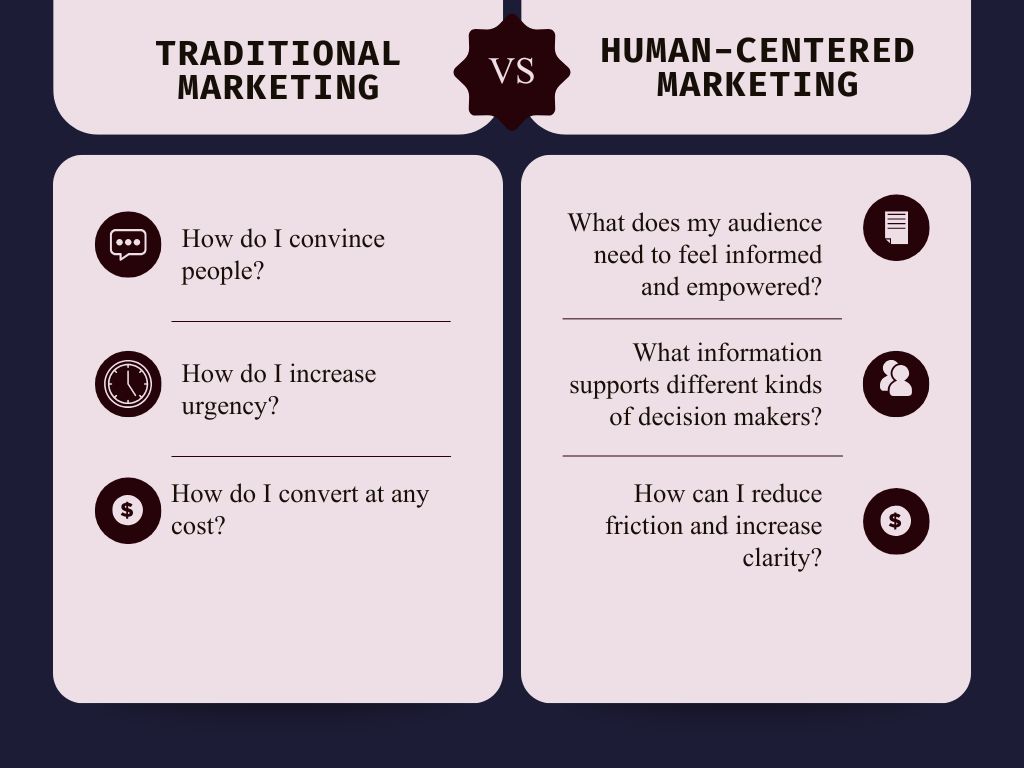
Instead of asking:
- How do I persuade more people?
- How do I increase urgency?
- How do I increase conversions at any cost?
Human-centered marketing asks:
- What does my audience need to feel informed and empowered?
- What information supports different kinds of decision makers?
- How can I reduce friction and increase clarity?
At its core, human-centered marketing integrates:
- Audience research rooted in empathy
- Clear, consent-based messaging
- Transparent offers and pricing
- Sustainable marketing systems
It elevates strategy to serve a brand and its audience.
How Is Human-Centered Marketing Different From Traditional Marketing?
Human-centered marketing has been developed as a solution to the ethical problems of traditional marketing. Traditional marketing often relies on:
- Scarcity pressure
- Emotional manipulation
- Artificial urgency
- Overstated transformation claims
Human-centered marketing prioritizes:
- Informed consent over coercion
- Clarity over hype
- Long-term trust over short-term conversions
- Nervous system regulation over fear
This doesn’t mean that you create passive, wishy-washy marketing. It means your persuasion is grounded in a real understanding of and respect for your audience instead of tactics designed to override critical thinking.
For service providers working in coaching, design, photography, wellness, consulting, or creative industries, this distinction matters deeply. Your business is relational. Your marketing should reflect that.
Why Does It Matter for Small Businesses?
Small businesses operate on trust equity. In other words, people have to trust you a lot before they’ll invest. Sometimes small businesses have to work harder than big brands for that trust.
Unlike large corporations, you don’t have massive ad budgets or brand recognition to rely on. You probably rely largely on:
- Referrals
- Reputation
- Word of mouth
- Repeat clients
Human-centered marketing strengthens all four. When your messaging respects your audience’s intelligence and agency,
- people feel safer in your sales process.
- your brand feels differentiated in a crowded market.
- clients arrive more aligned and less skeptical.
- retention improves.
There’s also an internal benefit: sustainability. Many small business owners burn out because they think their marketing “doesn’t work.” In reality, their strategy is misaligned with their values. Human-centered marketing reduces cognitive dissonance. It creates congruence between what you believe and how you sell. That congruence is powerful.
What Are the Core Principles of Human-Centered Marketing?
There’s no industry standard for effective human-centered marketing. At Brandcendent, I’ve developed these guiding pillars based on my trauma-informed training and experience supporting dozens of brands:
1. Clarity Over Cleverness
I always tell my clients, “Clear is better than cute.” Clear messaging reduces anxiety. It tells people exactly:
- Who your service is for
- What it does
- What it costs (or how pricing works)
- What results are realistic
Clarity converts more effectively than vague aspirations, too.
2. Informed Decision-Making
Provide enough information for someone to decide without a sales call ambush. This might include:
- Process breakdowns
- FAQs
- Investment ranges
- Timelines
The goal is to reduce ambiguity. It’s one reason good web copy is so critical.
3. Long-Term Thinking
Instead of chasing viral spikes, human-centered marketing builds assets like:
- SEO-optimized blog content
- Evergreen email sequences
- Conversion-focused website copy
- Lead magnets that genuinely help
These assets compound instead of demanding the constant content generation that comes with social media marketing.
4. Human Craftsmanship
Have you ever read an email or a blog post and thought, “Yeah, ChatGPT spat that out”? It’s alienating and creates distrust between the audience and brand. Human-crafted content connects with people in a way AI-generated content can’t. Aside from lacking humanity, AI doesn’t offer new ideas or data to help you stand out.
In an age where everyone is taking shortcuts on LLMs, humanity is becoming a huge differentiator.
Does Human-Centered Marketing Still Convert?
Yes. Often better.
In my experience, human-centered marketing actually increases conversion quality. Businesses experience
- Fewer refund requests
- Fewer misaligned inquiries
- Higher retention
- Higher lifetime client value
When someone opts into your list, books a discovery call, or hires you, they do so because they feel informed, not pressured. That foundation creates stable revenue.
How Can Small Business Owners Start Practicing Human-Centered Marketing?
You don’t need to reinvent the wheel here. Human-centered marketing is a practice. Start with these adjustments:
1. Audit Your Website Copy
Ask:
- Is this clear or vague?
- Am I overpromising?
- Do I explain my process?
- Am I clear about pricing?
Replace hype language with specificity, and provide clarity without overwhelming visitors.
2. Align Your Content With Search Intent
Rather than creating content based only on what you feel like posting, build an SEO content plan that answers real questions your audience is typing into Google and LLMs.
This approach:
- Increases web traffic
- Reduces reliance on algorithm volatility
- Attracts high-intent leads
Most importantly, this approach helps you build trust by providing answers your audience really wants.
3. Simplify Your Calls to Action
Not every piece of content needs urgency. Sometimes the invitation is simply: “Join my email list for thoughtful marketing insights.”
Simplicity builds safety.
Want more examples of trauma-informed shifts you can make in your marketing? Check out this blog post.
What Role Does Email Marketing Play in Human-Centered Marketing?
Email is one of the most ethical marketing channels available to small businesses.
Why?
Because it’s
- Permission-based: People have to opt in and can opt out at any time.
- Long-form: You get to lay everything out without the temptation to create clickbait.
- Not algorithm-controlled: You really get to focus on the humans on the other side of the email.
That means that your email list is a space where you can:
- Educate deeply
- Share nuanced perspectives
- Build relational trust
- Sell without shouting
If social media is borrowed land, your email list is owned property. Human-centered marketing prioritizes owned platforms because they’re more sustainable for you, the business owner.
How Do You Build a Sustainable Human-Centered Marketing Strategy?
A sustainable strategy integrates three layers:
1. Search Visibility
SEO blogging aligned with your offers ensures you have content working for you 3+ years after it’s published.
2. Conversion Infrastructure
Ethical website copy guides visitors through the client journey from brand awareness all the way to conversion.
3. Relationship Nurture
Email marketing supports trust-building and informed decision-making. Plus, it can be automated.
When these systems work together, marketing becomes less reactive and more predictable. This is especially important for service providers who want:
- Fewer frantic launches
- Fewer last-minute sales pushes
- Steadier inquiries
Human-centered marketing is a path to more reliable inquiries that don’t require dysregulation from us or our clients.
Does Human-Centered Marketing Work in My Industry?
Nope!
While it resonates strongly with therapists, educators, creatives, and coaches, the principles of human-centered marketing apply to any service-based business that values ethical growth.
The differentiator is not industry; it’s intention.
If you believe:
- Clients deserve transparency
- Sales should feel safe
- Growth should not require burnout
Then human-centered marketing is aligned with you.
Here’s a list of some of the industries I’ve supported with this approach:
- Photography
- Videography
- Web design
- Home organizing
- Parenting
- Fine arts
- Logistics
- Product-based services
- Journalism
- Coaching
- Event planning
- Education
- Social media management
- Human resources
- Construction
What Happens When Marketing Feels Aligned?
In my experience, businesses experience shifts externally and internally.
Externally:
- Your audience trusts you faster.
- Your messaging cuts through noise.
- Your inquiries improve in quality.
Internally:
- You stop dreading visibility.
- You feel less pressure to perform.
- You build assets instead of chasing attention.
Alignment creates sustainability. Sustainability creates growth.
If this approach resonates, you don’t need to overhaul everything tomorrow. You need a structured plan.
Inside my email list, I share:
- Sustainable SEO strategies for service providers
- Website messaging frameworks that convert without coercion
- Ethical sales insights
- Practical systems to reduce marketing overwhelm
Growth should feel stable. Your marketing should support your humanity, not override it.
If you want marketing that feels clear, grounded, and strategic, not frantic, join my list.






be the first to comment