




For years, I’ve provided SEO services for service providers and creatives. Nearly every one shows up to our initial call with the same feeling. They’re exhausted from trying to keep up with social media trends, daily posting schedules, and algorithm shifts. Sound familiar?
Many service providers are quietly wondering: Is there a marketing channel that doesn’t require me to push out content daily to get visibility?
Yes. It’s SEO.
There are so many advantages to SEO for service providers. Despite what you may have heard, it doesn’t have to be technical, overwhelming, or reserved for large corporations.
This guide breaks it down simply so you can understand how SEO works, why it’s powerful for service-based businesses, and how to implement it in a sustainable way.
- What is SEO? And what’s GEO?
- What’s unique about SEO for service providers?
- Why is SEO especially powerful for service-based businesses?
- Is SEO complicated or technical?
- What are the core components of SEO for service providers?
- How long does SEO take to work?
- How can you integrate SEO into human-centered marketing?
- What does a simple SEO plan look like?
- How do you get started with SEO for service providers?
What is SEO? And What’s GEO?
SEO stands for Search Engine Optimization. It’s the process of optimizing your website and content so that search engines like Google understand what you do—and show your content to people searching for it.
In plain language, SEO is what you do to get found in search results.
You start with the question: What are my ideal clients already typing into search engines?
If someone searches:
- “Website copywriter for therapists”
- “SEO strategist for coaches”
- “Brand messaging help for service business”
SEO ensures your website has the structure, language, and content necessary to appear in those results.
Recently, another term has entered the conversation: GEO (Generative Engine Optimization).
GEO refers to optimizing your content so it appears in AI-powered search experiences. Think ChatGPT, Google’s AI summaries, and other conversational search tools. Instead of simply ranking in traditional search engine results, your content may be cited or summarized directly in AI-generated answers. That’s critical as an increasing number of people prefer AI search to traditional search engines.
The good news? Strong SEO practices naturally support GEO. Good SEO content
- Answers clear questions
- Uses structured headings
- Demonstrates expertise
- Provides comprehensive, well-organized information
Those same characteristics make it more likely to be surfaced in both traditional search results and AI-generated responses.
You don’t need to master two entirely different systems. You need clear, authoritative content built on strategic keyword alignment.
What’s Unique about SEO for Service Providers?
While SEO principles apply across industries, SEO for service providers has distinct nuances compared to product-based or e-commerce businesses.
Here’s what makes it different:
1. You’re Selling Expertise, Not Inventory
E-commerce SEO focuses on product pages and transactional keywords like:
- “Buy blue linen dress”
- “Best noise-canceling headphones”
Service providers sell:
- Strategy
- Transformation
- Ongoing support
This means SEO must emphasize:
- Authority-building content
- Educational blog posts
- Trust signals
- Clear service page messaging
Your content needs to demonstrate competence before someone ever books a call. In fact, you’ll probably aim to answer questions that potential clients have before they ever explicitly search for your content.
2. Search Intent Is Often Relationship-Driven
When someone searches for a service, they are often evaluating:
- Fit
- Approach
- Philosophy
- Values
For example:
- “Trauma-informed marketing consultant”
- “Ethical SEO strategist”
- “Wedding photographer who captures candid moments”
Your SEO strategy must reflect not just what you do but how you do it.
That’s why messaging clarity and positioning matter so much in SEO for service providers. Ranking alone isn’t enough. Once they land on your site, the right clients need to feel the alignment.
3. Local and Niche Keywords Matter More
Service providers often operate in specific geographic regions and within specialized niches. This means your SEO strategy should include:
- Location-based keywords (if applicable)
- Industry-specific long-tail phrases
- An awareness of the problems potential clients are trying to solve
Instead of competing for broad, high-volume terms, you focus on:
- Precision
- Relevance
- Conversion likelihood
Targeted traffic converts better than generalized traffic. In my experience, this is one of the biggest ways that SEO strategy has changed over the last five years.
4. Conversion Infrastructure Is Critical
Unlike media websites that monetize through ad revenue, service providers rely on converting visitors to clients. That includes tools like
- Discovery calls
- Inquiry forms
- Email list opt-ins
SEO for service providers must integrate:
- Clear calls to action
- Strategic internal linking
- Optimized service pages
- Trust-building blog content
All of those elements have to be present on every page from your homepage to your blog posts. Visibility without conversion pathways leads to traffic but not revenue.
5. Sustainability Matters More Than Volume
Some SEO agencies recommend aggressive publishing schedules. Service providers often:
- Have limited capacity
- Wear multiple hats
- Cannot produce daily content
The most effective SEO for service providers strategies prioritize:
- Quality over quantity
- Strategic keyword mapping
- Consistent but realistic cadence
SEO for service providers is a trust-building system designed to attract aligned clients steadily and predictably. It should reduce burnout, not create more of it. Even if you outsource your SEO and blogging (which can be great if you have limited capacity), it should simplify your life.
Why Is SEO Especially Powerful for Service-Based Businesses?
Service providers sell expertise, transformation, and relationship-based work. Those purchases typically involve research. People Google or head to AI search before they:
- Book a therapist
- Hire a photographer
- Invest in website copy
- Commit to coaching
That’s even true of many potential clients who discover your brand on social media. They’ll search for your website, web presence, and reviews before inquiring.
To that end, it’s important to understand which search behavior signals readiness. When someone searches for a specific service, they’re often further along in the buying journey than someone casually consuming social content.
SEO allows you to:
- Show up during the decision-making phase
- Demonstrate authority through educational content
- Build trust before a discovery call ever happens
In other words, SEO warms up your leads before you speak to them.
Is SEO Complicated or Technical?
SEO can be technical, but it doesn’t need to be. A great example of this is alt text. Alt text is an image description you add to images on your website. It’s a disability accommodation and SEO tool. You can learn more about a tech-light, straightforward approach to alt text in my free guide. Grab your copy here.
It’s understandable that many service providers expect to get overwhelmed by tech. SEO conversations often include jargon like:
- Domain authority
- Backlink profiles
- Schema markup
- Technical audits
While those elements matter at scale, effective SEO for service providers often comes down to three foundational components:
- Keyword alignment: Understand what people are actually searching and how your keywords from different pages work together to rise all ships.
- Strategic website structure: Implement a clean, easy-to-navigate website structure. That improves user experience and makes it easier for search engines to crawl your website.
- Consistent, high-quality content: Create content that answers questions thoroughly at a cadence that makes sense for your capacity.
You don’t need to become a full-time SEO specialist to leverage search engine marketing in your business. You need a clear, focused strategy aligned with your offers.
What Are the Core Components of SEO for Service Providers?
Let’s break down the most impactful pieces of SEO in plain language.
1. How Do Keywords Fit Into SEO?
Keywords are the phrases your ideal clients type into Google.
Strong SEO begins with identifying:
- What your audience searches
- How often they search it
- What intent is behind the search
For example:
- “SEO for service providers” shows informational intent.
- “Hire SEO strategist” shows commercial intent.
Search intent is so important. You may be so immersed in your field that you don’t realize what the average person associates with a certain phrase. For example, one of my SEO blogging clients wanted to promote her Super 8 videography services. It turns out that most people searching “Super 8” are looking for the hotel chain. We had to adjust our keyword strategy accordingly.
You also want to create content that meets people in different parts of the sales funnel. A strategic content plan targets both:
- Educational keywords to build traffic
- Decision-stage keywords to generate leads
2. Why Does Website Structure Matter?
Search engines prioritize clarity. It’s also critical for human users. If someone lands on your website and can’t figure out how to find the information they want, they’ll leave. This is bad for your business because you’re losing potential customers. It’s also bad for your SEO because Google interprets it as you not having information relevant to that user’s search query.
Your website should clearly communicate:
- Who you serve
- What you offer
- Where you’re located (if relevant)
- What problems you solve
Optimized service pages are critical for converting search traffic.
Each core service should have:
- A dedicated page
- Clear H1 and H2 headings
- Targeted keyword integration
- Frequently asked questions
Structure reduces confusion for both search engines and humans.
3. How Does Blogging Support SEO for Service Providers?
Blogging is the engine that drives ongoing visibility. It broadens your reach to people who are searching for many keywords related to your main services.
A strategic blog:
- Answers specific client questions
- Targets long-tail keywords
- Internally links to service pages
- Builds topical authority
For example, a photographer might write:
- “What to Expect from Film Wedding Photography”
- “How to Plan for a Lifestyle Newborn Session”
- “DIY Family Photos vs Professional Family Photoshoot”
Each post supports the core service page and answers questions thoroughly. Over time, this creates a web of relevance and improves your rankings.
Want more tips on converting visitors to clients? Check out this blog post.
How Long Does SEO Take to Work?
SEO doesn’t give instant results. Typically, service providers see measurable traction within:
- 3–6 months for early traffic
- 6–12 months for consistent lead generation
It’s a long game for sure. When social media stats give us instant highs (or lows), it can be hard to embrace the slow and steady pace of SEO.
The thing is, social media resets daily and, in some cases, hourly. SEO, on the other hand, compounds over years.
A well-written blog post can:
- Rank for years
- Generate inquiries without daily effort
- Support launches and promotions
- Provide content for your email newsletter
Think of SEO as building infrastructure rather than chasing momentum. When done correctly, SEO for service providers becomes one of the most stable marketing channels available.
How Can You Integrate SEO into Human-centered Marketing?
At Brandcendent, I work with ethical entrepreneurs who want to connect with other humans through their work. That includes their marketing. SEO absolutely can be a powerful tool for human-centered marketing.
SEO is not inherently manipulative. It’s simply a visibility tool.
In fact, SEO supports ethical marketing because:
- It meets people where they are already searching.
- It allows for educational, long-form content.
- It prioritizes informed decision-making.
Instead of creating urgency through scarcity tactics, you create clarity through information. You can build trust. For service providers who value transparency and trust, SEO can be deeply aligned.
What Does a Simple SEO Plan Look Like?
A streamlined approach to SEO for service providers might look like this:
- Identify 10–20 high-value keywords aligned with your services.
- Optimize your core service pages.
- Publish 2–4 strategic blog posts per month.
- Internally link content consistently.
- Track traffic and inquiries quarterly.
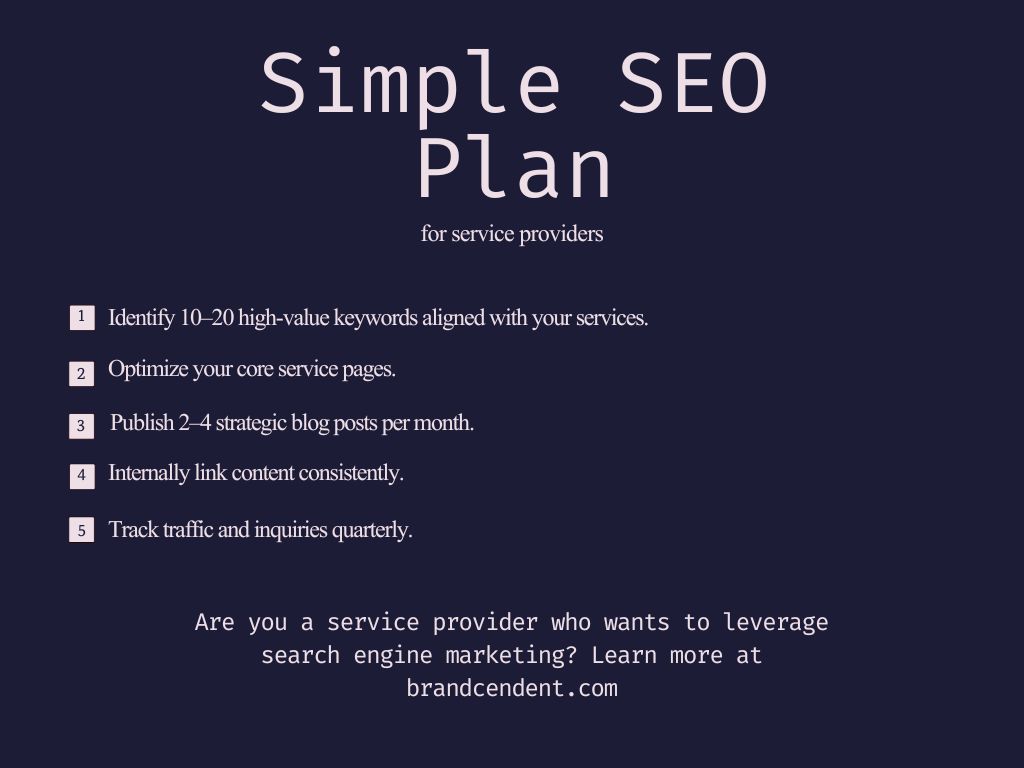
That’s it. No daily posting requirement or pressure to go viral. Just steady, strategic visibility.
How Do You Get Started with SEO for Service Providers?
You can either DIY your SEO or outsource it.
You may be ready to outsource if:
- You know SEO matters but don’t have capacity.
- Writing optimized content feels overwhelming.
- You want a long-term strategy, not scattered posts.
- You’re aiming for consistent, qualified leads.
- You have more money than time to invest in SEO.
Outsourcing allows you to:
- Stay in your zone of genius.
- Build authority through expert-led content.
- Maintain consistency without burnout.
- Focus on the clients you already have while attracting future ones.
For many service providers, consistent execution, not knowledge, is the missing piece.
Imagine:
- Receiving inquiries from people who found you on Google.
- Booking discovery calls with pre-educated leads.
- Seeing traffic grow without increasing your social media output.
- Feeling less pressure to “show up” every day online.
That’s the power of SEO for service providers when it’s implemented simply and strategically. You don’t have to worry about gaming algorithms anymore.
If you’re curious what an aligned, sustainable SEO strategy could look like for your business, I’d love to help you get some clarity.
Inside Brandcendent’s Blogging Pricing Guide, you’ll find:
- What strategic SEO blogging includes
- Investment ranges
- Answers to FAQs
If you’re tired of marketing that feels loud, reactive, or exhausting, SEO may be your steadier path forward.







be the first to comment